
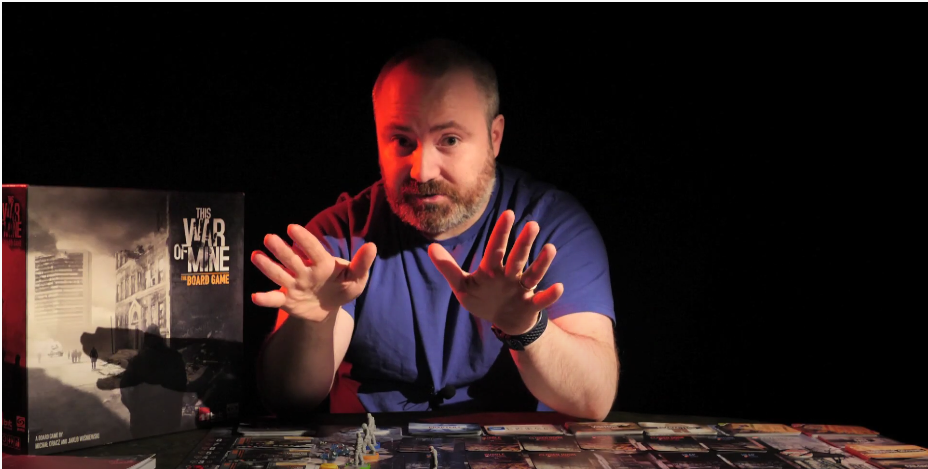
This review by Sean, at The Lucky Roll, is one of the best reviews of a game that I have seen. He has a way of portraying the heart of the game, how it draws you in, and how it can affect you both during and after the game has concluded. His review was so good that I actually wanted to provide you with a full transcript of it. So I watched it over and over a few times and typed up the transcript, which I am placing below the video:
Hello and welcome to the Lucky Roll. Today, we’re looking at This War of Mine: The Board Game. A game by Michał Oracz, Jakub Wiśniewski and based upon the computer game of the same name. This game is set in the fictional city of Pogoren, a city under siege and gripped in the midst of a horrific civil war, and it’s based upon the real life events that happened in the siege of Sarajevo during the Bosnian conflict from 1992 to 1996. The siege of Sarajevo was the longest siege of a city since World War II, and the stories that came from the poor living conditions and atrocities inflicted upon the populace at that time, have inspired the stories that players experience within this fictional city of Pogoren in This War of Mine: The Board Game is set in.
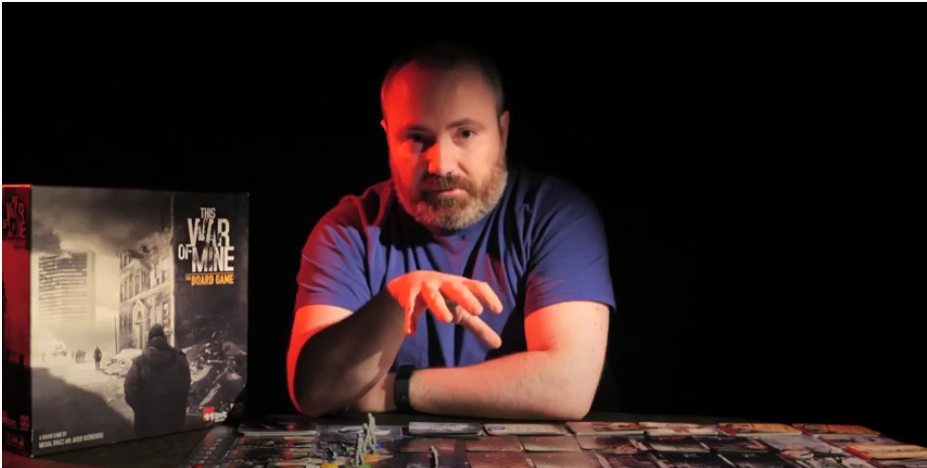
It’s a storytelling, push your luck, resource gathering, worker placement style of game, where the players play a group of civilians trying to survive. The game play takes place with several different phases, such as Dawn where players develop the shelter that they are residing in, to Dusk where they must eat and drink in order to stay alive, to Evening where players decide how the group splits up, with some characters braving the streets at night in a Scavenging Phase and others remaining at home in order to guard the shelter during the Night Raid Phase. Players repeat this cycle with a fresh new event every morning, managing their survivors and resources until the end of the war is reached and a ceasefire declared, or until all characters have died.

The board is the deck with a multitude of cards that cover everything from resource gathering to exploration to room development, story progression and challenges. There is some dice rolling and strategy involved, but the bulk of the game mechanics is based upon the decisions players make when offered a choice and how the consequences of those choices spiral on from there with the combination of dice rolling and random chance affecting how events impact players. There are a lot of non-traditional elements to this game from the unique instruction book to the horrific subject matter it deals with, to the most unique aspect, which is the actual player mechanics and player interaction in the game. Unlike other survival games, such as Dead of Winter where players have a unique character or avatar they play as in the game. The characters survivors of This War of Mine are shared amongst all the players. The game can accommodate up to six players, but you will never have more than four unique survivors or playing pieces on the board at any given time. That’s what makes this game unique.

On a player’s turn, they make a decision that affects the entire group as opposed to a singular character piece that they are represented by or responsible for. So what is rotated amongst players in their turn essentially is the mantle of leadership, or to put it more simply, final say on the current decision that faces the survivors. It doesn’t matter if the majority of the players are against your ultimate decision; If it’s your turn for leadership, you have final say. The only compromise on this is that you must listen to other players before making your executive decision, and this is something I quite like about the game, as it gets the players to care about the survivor characters as a group, as opposed to their sole character avatar and its sole place in the game.
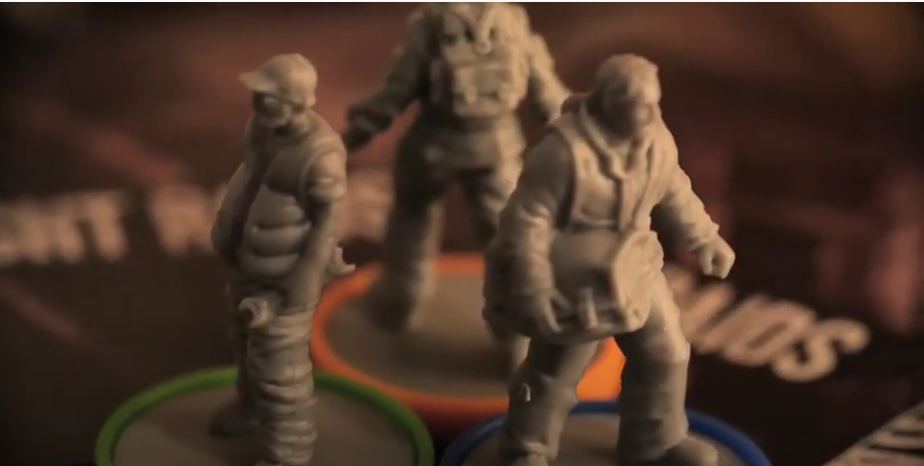
You may initially have little to no concern for the character of Anton, the elderly Maths professor, for example, but fate during the game may conspire to make you the sole person responsible for whether or not he survives. And regardless of whether you initially empathize with the survivor or not, you end up deeply invested in them as you work and sacrifice as a group to keep them alive.
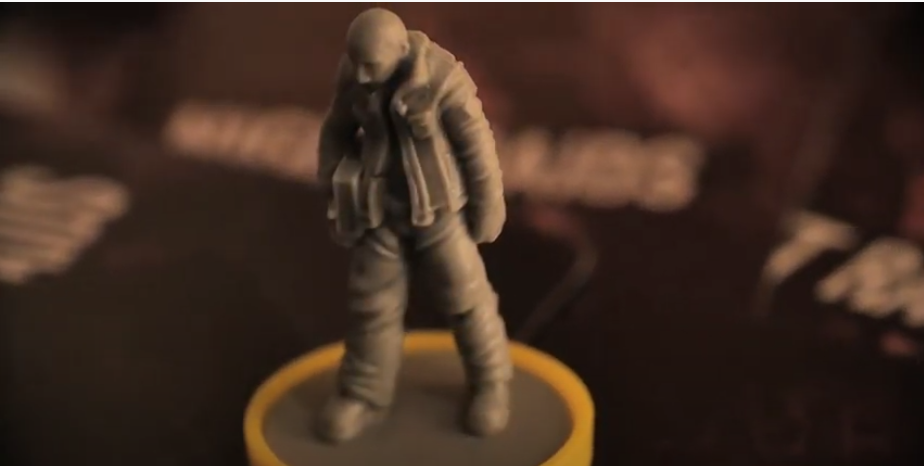
Anton’s determination to stay alive as a promise to his students, for example, resonated with me deeply, the first time I learned about his character in a solo playing session, as I’d prior to that callously dismissed him as a needless burden the first time I drew him [from the deck of Characters], slightly resentful that, despite having drawn two other, powerful and useful starting characters in that game, my session would be impacted needlessly by trying to keep him, Anton, alive, to the probable detriment of the other characters. Learning more about him however, as the game developed, humanized the character of Anton for me and I found that I cared for him most of all and imagined him as the nucleus of the group, as the other characters of Marco, Roman and Boris secretly strove to keep him alive in order to keep despair from setting in amongst all of them.

Now, sadly in that particular game, Anton eventually succumbed to the misery surrounding him and committed suicide and this impacted and affected me a hell of a lot more than I thought it would be possible for board game to ever affect me. There was a grim and terrible beauty to this game, but despite its brilliance, it does affect you.
This is a game where I rarely ever felt good afterwards. It is thought provoking, morbidly fascinating and allows you to explore humanity at both its very darkest and its very best. It is both an experience and an endurance, but despite its very grim overtones, it’s a game I continually keep coming back to. There are 13 survivor characters with various skills and weaknesses and having played the game a multitude of times I found myself empathizing with every single one of them.
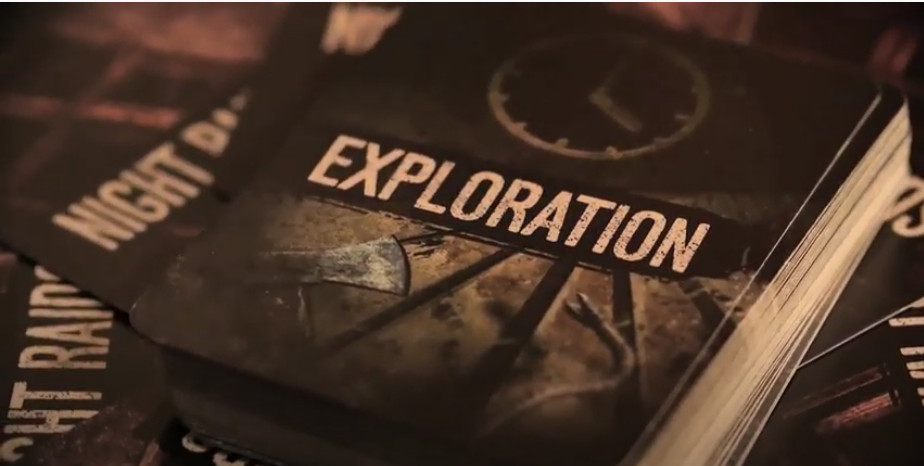
The variety of skills they offer along with the multitude of directions your choices send you off to make sure that this is a game with an awful lot of replayability. There are parts of the game where you were prompted to read from a Book of Scripts, and these elaborate upon both the story and impact that certain events from the game have upon you.

Now and again you’ll come across a story text that you’ll have come across before but ultimately there’s so many scenarios in the script that you will spend an awful, awful long time playing this game before it is played to exhaustion. The Book of Scripts is where the guts of the story and atmosphere of the game resides. But given the versatility of the mechanics of the cards and the randomness afforded upon us again, by both the dice and the choices made by fate and color cards, it’s not something that will become a burden in a playing session.
For example, trading with soldiers is always a risk because you must roll a dice afterwards. And if you roll a low number, the soldiers decide to purely attack you and rob you of precious resources before letting you go and rendering the initial trade pointless.
Another example of this was when soldiers rounded up the entire street and assigned each character a number. You roll the dice, and the character whose number comes up is shot, I know one in 10 chance each time I rolled the dice of one of my characters being arbitrarily murdered. And devastatingly two of the group of three were killed due to incredibly unlucky dice rolling on my part at that time.
As a solo player the entire game is fascinating. It is continually engaging and gripping and in my opinion flawless. As a group however is where the game to me is at its weakest. Now don’t get me wrong, it’s still an incredible experience. Everyone I’ve played this game with has been both moved and absorbed by this game. There’s great value at substance to be had in engaging with this game as a shared experience. But extra players slow down the progression of the game exponentially. And the base that was brilliantly engaging with seasoned players of this game turns into a rules explanation session with newer players as they are told continually what to play or to do as opposed to deciding to do so themselves. However, that is, to be fair again, fixed with familiarity with the game.

This Scavenging Phase however, is at its best in the shared experience. Players explore areas by turning over exploration cards and discerning upon the choice presented to them. With a group experience, this is rotated around the players very quickly and the pressure and dread that certain people felt as the group responsibility fell upon them was incredible to witness. One of my friends, both loved and utterly hated this part of the game, as she was literally at the edge of her seat whenever her leadership turn came up, and confessed to me how much she hated having all the ultimate responsibility thrust upon her when deciding these characters fate during the Scavenging Phase.

This is a level of immersion and investment I have rarely ever seen in other games, especially in specific moments. In part this is also due to the difficulty of the game. This is a hard bloody game and your survivors will die no matter how hard you strive to save them all. There’s no nonsense entertained here. Characters will die arbitrarily from unfortunate events; and most definitely die if you make careless decisions.

One particular session. I remember playing was cut short as the leader at the time decided to attack armed soldiers with our unarmed survivors during the Scavenging session. Now, despite our arguments to the contrary, he was convinced that the characters would make a good account of themselves and then ended up being shocked at how easily they were cut down, and how one character’s decision on his part, had killed two people. It was an element of realism that he didn’t expect as he was so used to computer games where soldiers were fodder to wage through as opposed to a real and genuine danger which is what they pose in this game. The continuous darkness of tone is also difficult upon group play. Despite everyone enjoying this game, it’s one I rarely have unanimous agreement for, as people come to game night to enjoy themselves.

The nights that we do play, however, are always memorable. We find ourselves talking about it for days afterwards. This game, however, I think is still at its best as a solo experience at least initially until you find or train the right group of fellow players to play this game with.
The last thing I want to say about this game, is that if board games could ever be described as art, then this game will be it. Art is mostly about engaging with the human experience in expression. And it’s done through many elements such as visual, musical, word and text. This however, is the very first time that a board game has conveyed the human condition to me as deeply as a piece of music, art or text.

Its gravitas is increased, of course, by its grim inspiration on real life events but this is not a game you beat or a puzzle you solve. It’s an experience you HAVE and you share! The moral choices inflicted upon you by this game give you scope to wonder what type of person you are and how you would personally behave when faced by some of the very grim choices in this game.

My initial feelings towards Anton, for example, surprised me when I reflected upon them at his death. Without intending to, I had devalued him as a person because he wasn’t as brave as Marco or as strong as Boris. Again, this was the clinical gameplay part of me, trying to strategize for the game ahead rather than an ingrained callousness made in me as a person, but it still reminded me that I was missing the point of this game… and that is to learn to live through these characters and what is a scenario, I genuinely hope that both you and I and any other person watching this video will never ever have to face. It’s an incredible game that is not for everyone. But if everyone played it. I think we would all be a hell of a lot nicer to each other.

So this is Sean from The Lucky Roll. If you enjoyed this video, please like, subscribe, all that good youtube stuff until next time. Good luck and God bless.
 This War of Ours
Leave a comment